Mathklyr
From the lore of Ghostblood
The concept of Mathklyr was born from a question. Most nations rise, endure, decay and then fall. But what if one nation had not fallen, and simply endured beyond its time? I think of Mathklyr as a "mummified empire", bending under the weight of tradition and thousands of years of rigidity, yet unable to break. It is said the Empire was cursed in ancient times, so that it could never die, only endure, no matter how nightmarish such an existence would be. Others claim the Empire's stagnation is due to factors beyond this fabled curse: Mathklyr's highly stratified pantheon of deities, the Kerrethain, is one example. Another could be the extended lifespan enjoyed by its Emperors. The truth is unknown, but Mathklyr is believed to have endured for over ten thousand years, and it shows.
Lands and peoples
Mathklyr is located on Teidar, the same continent as Ailund and Irig. In fact, some of the slavers Riyya mentions as raiding Irig in North Star may well have come from Mathklyr, or from kingdoms influenced by its culture such as Imbrar or Tonalay. Irig itself isn't in Mathklyr's sphere of influence, though Tonalay and Imbrar have at times fought the Empire for their very survival. These three kingdoms share similar cultural roots and speak variants of the same language, Kreylvos. Collectively, they are known as the Kreylvos lands.
Mathklyr is primarily populated by humans, who make up more than 75% of its population. The Empire is one of the few places left where an ancient human people, the kadalorans, can be found in large numbers. The rest of the population belongs to other species, including the nurain (mostly as slaves), giants and half-giants, and a small number of ogotai. While humans are well integrated among themselves, the other species tend to keep to themselves, either in the mountain ranges that surround much of Mathklyr or on the fringes of the Broken Lands to the west.
Five ways to speak one language
It would be more accurate to say Mathklyr speaks five variants of Kreylvos. The language has evolved along social class lines rather than geography. Mathklyr's regimented society forces members of the major social classes (slaves, lowborn, highborn, nobles and warriors) to speak only their own dialect; using another caste's dialect is considered at best an insult, at worst a crime, especially if the lowborn or the slaves do so. The dialects are mutually intelligible, and every speaker instantly knows which one the other person is using.
Emperor and nobility
The government of Mathklyr is firmly in the hands of the nobility, and the Emperor has absolute power over the Empire, as has been the case since its founding. The burden of tradition, however, limits the Emperor's power somewhat, just as it limits the freedom of the lower classes. The mysterious ceremony of the Crowning of the Emperor endows the new Emperor with an extended lifespan, roughly twice the normal lifespan of his people.
Mathklyr is a warlike Empire, and its soldiers, though old-fashioned, are among the elite armies of the continent. They are led by a handful of Mathklyrian Warshifters, men with a supreme aptitude for strategy, tactics and military matters, trained to become geniuses of the craft in a fiercely competitive environment.
Castes
Social structure is everything in Mathklyr. There are seven castes, grouped into four social classes: the slaves; the lowborn, farmers and artisans; the highborn, merchants and minor noble Houses; and the nobles, the major noble Houses and the Imperial House. The warriors stand outside this hierarchy: they have their own dialect of Kreylvos, but are not a caste of their own.
Rising from one class to the next is unthinkable, except under extraordinary circumstances: men enter the military, where a distinguished career might earn an elevation; women marry into a higher class, if they can. Mathklyr is also deeply sexist. Women are seen as second-class citizens, barred by law or tradition from most work, expected to marry and bear children, and considered subject to the men in their lives. Independent women who do not conform are hardly tolerated. Most Mathklyrians wouldn't know how to behave before such a woman, and would likely ignore her as if she were invisible.
Both men and women wear a traditional item that shows their social class. Men wear the katain, a dagger with a gemstone set in its pommel, from the malachite of commoners to the blue diamond of the Imperial family. Women wear the kadala, a delicate hair net with a diaphanous veil covering the lower half of the face, and a teardrop gem on the forehead in the same stone as the katain.
A weary empire
Ten thousand years of tradition permeate every facet of Mathklyrian life, and its people are so used to it that they move through a rigidly defined existence beyond which they cannot see. Mathklyrians are fascinated by death, and they hold their death goddess, the Lady Oinrin (whom northern scholars link to the Lady of Souls), as the most important deity of the Kerrethain. Death permeates everyday life, which looks grim and gloomy to outsiders, especially in the great cities. Only by entering one of them can one understand why Mathklyr is called "the mummified empire": there is no energy or enthusiasm in any everyday activity. The empire has been in its death throes for millennia.
Laws in Mathklyr are harsh, and the Emperor can change them at will, with one exception: the laws etched on the Stele of the Emperors can never be changed. There are few of them, but each has shaped the Empire irrevocably since it was carved.
Faith
The Mathklyrians worship their own pantheon, the Kerrethain. It is a large pantheon, with several aspects for each deity (each at once a mask worn by the deity and an entity in its own right), and composite deities considered "children" of their parents. Its chief deity is the Lady Oinrin, goddess of death, fate and sovereignty, also known as the Raven Queen. She gives her name to the throne of Mathklyr, the Raven Throne, and is closely associated with the Emperors. Rumor has it that the Emperors meet her during their crowning, though others dispute this.
Read Ghostblood
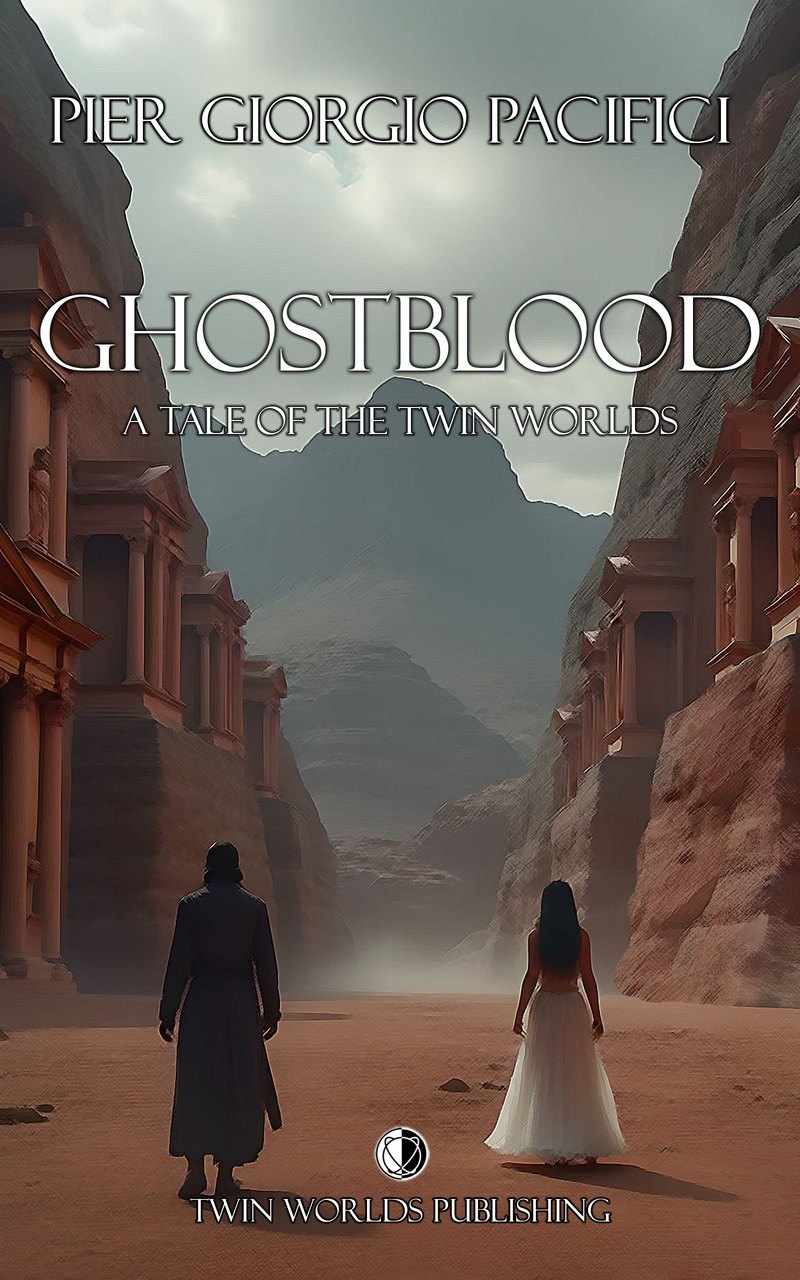
Revised edition
Ghostblood
An empire ten thousand years old, cursed never to die.
In Mathklyr, tradition is law and the goddess of fate decides every life. Alric chooses the soldier’s path and climbs. Elis refuses hers and is exiled for it. Years later she returns with knowledge that could break the empire, and the two meet again in the necropolis where emperors are crowned.
More from the Codex
- Lady Oinrin
Goddess of death, fate and sovereignty, and the power behind the Raven Throne.
From the lore of Ghostblood
- Ellemere
The last great forest of Teidar, and the one road its guardian allows through it.
From the lore of Ghostblood
- Nature magic
Magic that can’t be learned, only granted, and the three limits every practitioner knows.
From the lore of Ghostblood
- Cosmology
Wandering Planes, Dimensions and the Void Between: what scholars know of the cosmos, and why so much was lost.
From the lore of the Twin Worlds